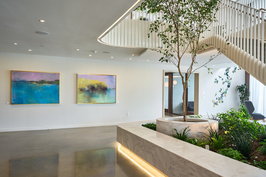
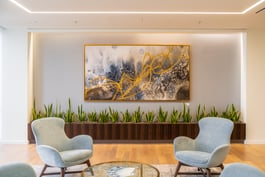
Financial advisory relationships are built on trust, and much of that trust takes shape in the physical environment where conversations happen.
As advisory firms increasingly draw from the same design playbook to project stability and credibility, those choices are diluting brand identity. Spatial differentiation, a coherent design language, and thoughtful site-specific details work together to build the kind of trust advisory relationships depend on.
Why Spatial Differentiation Matters
Advisory offices often draw from a shared design vocabulary meant to project stability and discretion. However, when similar and competing firms use the same visual cues, those cues become less effective. Branding consultancy DeSantis Breindel describes this pattern across professional services as a “sea of sameness,” where similar firms build their brand around the same handful of attributes, like integrity, expertise, and client experience, that end up functioning as baseline expectations rather than points of distinction (Breindel, 2024). The same pattern is true in physical spaces that draw on the same narrow set of design conventions as every other firm in the field. Advisory rooted in relationship building, and a firm's physical spaces are one of the clearest signals clients use to judge whether a firm is one worth building that relationship with.
The “servicescape” is a term defined by Mary Jo Bitner (1992), a leading researcher and professor in the field of service marketing. The term describes “the physical surroundings that impact the behaviors of customers and employees in service organizations.” Bitner’s research reveals how ambient conditions, spatial layout, and physical details communicate meaning to clients and can shape their perception of a firm independently of service quality.
More recent research builds on these principles, finding that as firms increasingly rely on experience-driven differentiation, the design of physical spaces becomes central to how a brand’s identity is communicated and perceived. However, many firms still struggle to translate an identity into a space that reflects it (Valentini & Roederer, 2026).
Building Trust Through Design
So what actually communicates trust?
A clear identity gives clients something to remember, but distinction alone doesn’t produce trust. Two main strategies elevate a space from just recognizable to one that communicates established reliability:
- Coherence: a consistent visual identity that ties together every location a firm operates.
- Meaning: details within a space that clients recognize and connect with.
For advisory firms, coherence shows up most clearly across locations rather than within any single office. Research on financial institutions has found that inconsistent branding across branches, from signage to materials to the physical environment itself, quietly erodes client trust, as it creates a sense of fragmentation, rather than centralized reliability (Deluxe, 2026).
Meaning operates differently. Bitner's original servicescape framework identified "signs, symbols, and artifacts" as a distinct dimension of physical space, separate from layout or ambient conditions, that communicates through representational visual cues (Bitner, 1992). Later research built directly on this idea describes a "symbolic servicescape,” as integrating intentional objects and artifacts that carry meaning clients can recognize and interpret, independent of how polished or unified the surrounding space is (Rosenbaum, 2005). A firm can be perfectly consistent across all locations and still communicate very little if nothing resonates with clients or speaks to the unique character of the firm.
Art as a Scalable Design Strategy
A strong visual storytelling strategy meaningfully strengthens a brand’s perceived authenticity and memorability (Naderloo, 2024). The difference between a thoughtful space and a templated one is acutely noticeable in a service setting where clients are expecting attention to detail.
Consistent choices in materials, lighting, color palettes, and spatial divisions can carry a firm’s identity between locations, while thoughtful details can be chosen to connect directly with that location’s clients. When strategically executed, these two levels reinforce each other rather than compete, as the coherent underlying identity travels across branches, while what’s chosen for a given space signals that a firm has taken the time to understand who it’s
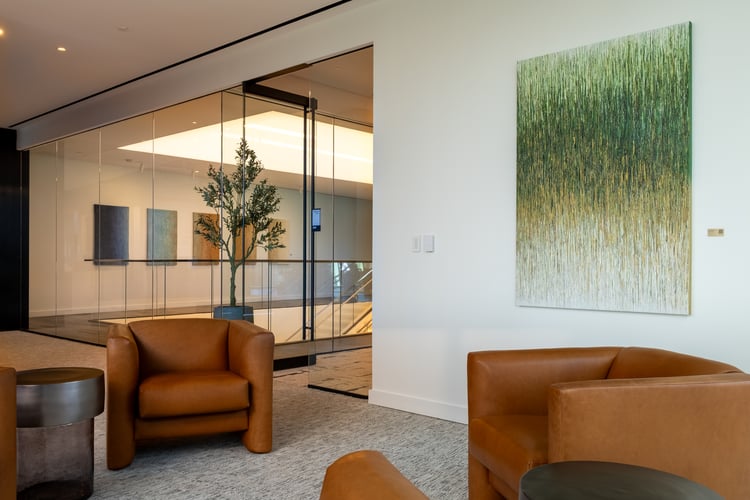
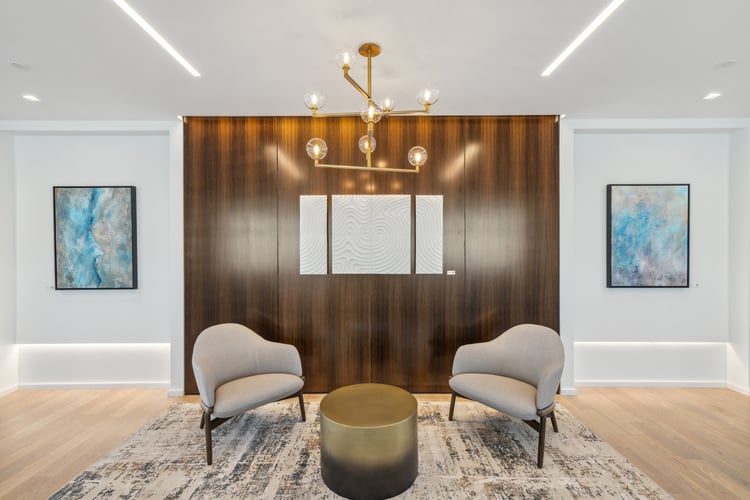
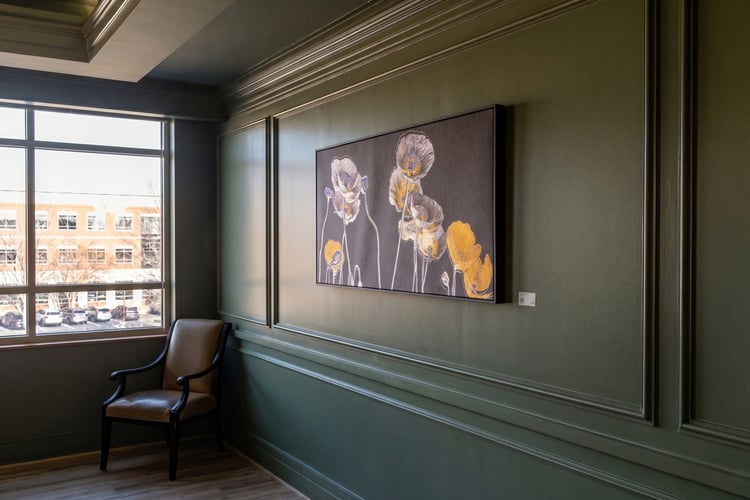
Thoughtfully selected art can shape a space that both adheres to a consistent brand design package and speaks directly to a specific location’s client base. A curated program can be built around brand styles or palettes while introducing recognizable subject matter, local talent, and regional identities to communicate an understanding of and care for the community each location serves.
Art also does more than communicate organizational values and identity. Clinical research on visual art in high-stakes settings, such as advisory environments where clients are navigating significant decisions, has found that thoughtfully integrated artwork meaningfully reduces anxiety and agitation (Nanda et al., 2010).
Sustaining Trust Over Time
The relationships advisory firms build are long-term, but the expectations clients bring to those relationships shift generationally. What reads as credible to one group of clients doesn't automatically resonate with the next, and a brand can lose its distinctiveness as expectations shift (O'Connor, 2025).
Merrill Lynch estimates that nearly $124 trillion in wealth will transfer primarily from the baby boomer generation to younger generations by 2048. Younger generations evaluate authenticity and brand trust through relationship quality, favoring transparency and a genuine sense of being understood over the traditional signals of expertise and legacy that shaped trust for older generations (McKinsey, 2026). A space calibrated to one generation's expectations may not register as credible to the next.
This shift reveals the need for an adaptable design approach that can respond to the evolving preferences and expectations of a younger client base without abandoning the core identity rooted in a history of earned trust.
This is where static design decisions present limits. A curated art collection can rotate and evolve as a firm's clientele changes, introducing work that reflects new aesthetics while maintaining alignment with the underlying brand identity and the coherent style built across offices. Art is a sustained design strategy that allows a firm to target an established client base and an incoming one, across every location, from the same coherent identity, rather than choosing between them.
How TurningArt Can Help
At TurningArt, we work with financial advisory firms to build curated art programs that reflect a firm's brand identity and hold together across every office it operates. Our Art Advisors partner with firms to select work that resonates with each location's clients while keeping the underlying identity, and the trust built around it, consistent from one space to the next.
Connect with an Art Advisor below to learn more!

.jpg?width=332&height=177&name=_MG_0840%20copy%20(2).jpg)
.jpg?width=332&height=177&name=dtBv_067_DSC_2139_DaNil%20(2).jpg)
.jpg?width=332&height=177&name=0046-Interior%20(4).jpg)