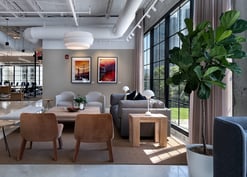
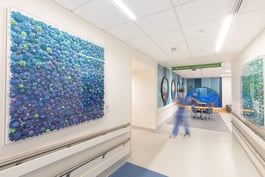
Art in commercial real estate has been treated as a finishing touch for too long, selected at the end of the process with little consideration given to its impact. That model is a missed opportunity, and increasingly, a liability. When art is positioned solely as decoration, it fails to contribute to important metrics like leasing appeal, tenant retention, and asset differentiation. With the shift toward hybrid work, rising tenant expectations, and intensified competition from hospitality-inspired spaces, the built environment has to work harder to deliver appeal.
At the same time, the overall art market has developed as an asset class. According to The Art Basel and UBS Global Art Market Report 2026, global art sales grew 4% year-on-year to an estimated $59.6 billion in 2025. This signals the growing recognition of art’s embedded experiential value. At the same time, human-centered design has become an essential consideration and a prerequisite for the built environment.
Strategically deployed art becomes infrastructure, and one of the strongest examples is in environmental graphics and wayfinding.
What Environmental Graphics & Wayfinding Actually Do
Environmental graphics and wayfinding are often reduced to signage. In reality, they function as a design system that shapes how people experience and move through space.
Environmental graphic design, or experiential graphic design (EXD), is a term that encompasses the full range of integrated visual elements–such as wayfinding signage, strategic color use, large-format printing, branded installations, and artwork embedded in architecture–that guide users through a space. EXD complements architecture and interiors, adding an additional, visual level of spatial personalization. These integrations are scientifically backed: studies emphasize EXD's role in creating memorable moments while adding functional value to physical spaces (Petković et al., 2025). By effectively leveraging these systems, people feel more connected to their environment from the moment they enter.
Similar research specifically on commercial environments reveals that integrated visual systems positively impact user engagement and experience (Yang et al., 2026). Wayfinding and navigation systems also have measurable cognitive and behavioral outcomes. A 2026 meta-analysis identified four major factors that contribute to how we experience our environment:
- Cognitive load – how much mental effort is required to navigate
- Situational awareness – user perception of their location
- Decision-making – how quickly and confidently users choose a path
- Emotional engagement – how the environment feels during navigation
These factors define how people will perceive a space across four dimensions: continuity, connectivity, accessibility, and environmental attractiveness (Jialu et al., 2026). Additionally, architectural cognition shows that visual salience, spatial legibility, and hierarchical structure have neurological impacts on the way that certain user groups perceive space (Bagheri & Pourfathollah, 2026). This research affirms the importance of tools like environmental graphics that make complex navigation systems effortless and enjoyable.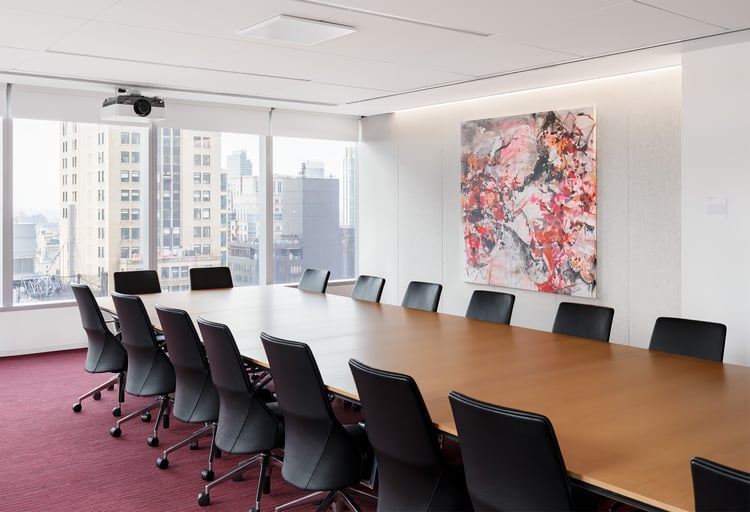
The Business Case: Identity, Leasing Appeal and Asset Differentiation
If environmental graphics shape experience, then they also shape demand. For commercial real estate projects, the question is whether they are worth the investment in the context of leasing and retention goals. Research on aesthetic investment shows that regions that integrate creative infrastructure see measurable economic outcomes (Bergamini et al., 2026). The same principle applies to real estate assets: creative infrastructure builds a unique and distinctive visual identity, helping locations differentiate themselves and stand out.
For example, according to the 2021 Art of the Workplace Report by Brookfield Properties and the School of Life, only 24% of employees feel inspired at work, but that rises to 39% in visually enriched environments. Importantly, nearly 70% agreed that engaging with art contributes to their well-being. Ultimately, these factors translate into higher occupancy rates and retention, as tenants choose spaces where their employees want to show up.
According to JLL’s Global Design Perspectives 2026, hospitality design strategies, such as environmental graphics and wayfinding systems, have become more relevant to the commercial real estate industry. These concepts center on neuro-design principles, which apply cognitive science to physical design to enhance both user experience and cognitive performance.
As a comparison, coworking spaces see better results in employee experience due to warm, comfortable atmospheres that foster a sense of belonging. Unlike traditional office environments, coworking spaces employ richer visual elements such as artwork, colorful graphics, and other design elements. Meanwhile, more traditional office environments often favor a neutral aesthetic with limited visual dynamism, which results in a more sterile feel (Muskat et al., 2025). These stylistic differences are becoming increasingly important to tenants and are ultimately tied to leasing and retention outcomes..png?width=750&height=500&name=Untitled%20design%20(2).png)
The Human Case: Navigation, Mental Clarity, Experience
Environmental graphics can positively impact people's experience in a space by creating a more comfortable environment.
Poor navigation increases stress, confusing layouts raise cognitive load, and environments that lack visual clarity demand constant mental effort just to interpret. On the contrary, well-designed spaces are easy to navigate, allowing visitors to concentrate on their activities. Research on workspace design and mental health confirms that spatial clarity and environmental design are directly linked to mental well-being (Kropman et al., 2022).
This is especially important in the context of hybrid work. Recent research proves that physical office environment conditions significantly influence employees' decisions to come to work, suggesting that "office design should be considered an integral component of organizational models of hybrid work" (Haapakangas et al., 2025). If the physical environment doesn't offer a compelling experience, people will simply prefer remote work.
This is where hospitality-led design, characterized by amenity-rich spaces, comes into play. Environmental graphics play an important role in navigation, reinforcing brand identity, and creating meaningful connections. This approach is increasingly popular in corporate real estate contexts, reframing employees as "employee customers" whose experience within a space deserves deliberate attention (Preece & Risch, 2025).
Another effective strategy in building for experience is biophilic design, which involves incorporating natural elements within built environments. Biophilic interior architecture helps increase emotional comfort and engages people's senses, positively influencing overall well-being (Abdullayeva, 2026). Importantly, researchers don’t treat biophilic design as a passing trend in contemporary interior architecture, but as a foundational design concept. For that reason, environmental graphics are highly practical for implementing biophilic design principles into commercial spaces.
Hybrid work pressures, hospitality-led design, neuro-design, and biophilic principles all indicate that the quality and accessibility of the physical environment are strategic property investments.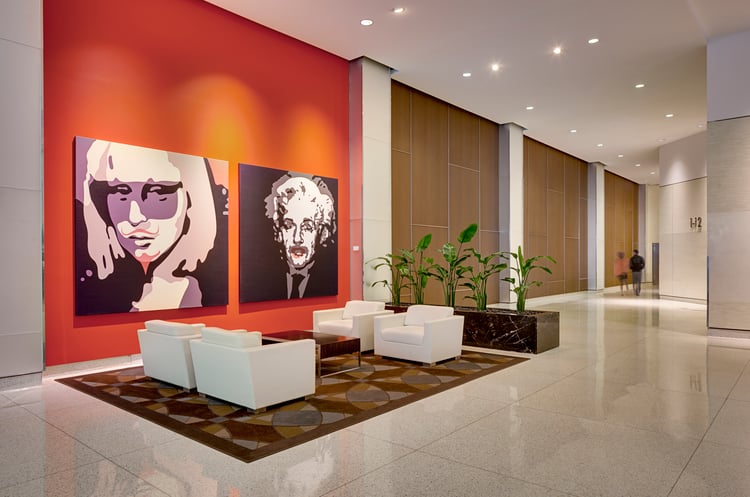
Art As Infrastructure, In Practice
Forward-thinking owners and designers are already realizing the potential of evolving art’s role from decorative to a strategically important part of project planning.
At TurningArt, that approach has been carried out from the beginning. From biophilic-driven installations that deepen a building's connection to its natural context, to fully integrated wayfinding systems and environmental graphics programs, our goal is always to create environments that maximize form and function.
How TurningArt Can Help
TurningArt recognizes that in today’s competitive market, art is more than an aesthetic afterthought. In commercial properties, it plays an essential role as a placemaking and tenant retention tool. TurningArt specializes in providing strategic art curation that transforms the built environment through visual programming aligned with your brand's goals and identity.
At TurningArt, we create visually compelling, functional spaces through the expertise of our Art Advisory team and the creativity of our TurningArtist network.
Connect with an Art Advisor below to learn more!

.jpg?width=332&height=177&name=0046-Interior%20(4).jpg)
.jpg?width=332&height=177&name=_MG_0840%20copy%20(2).jpg)
.jpg?width=332&height=177&name=dtBv_067_DSC_2139_DaNil%20(2).jpg)