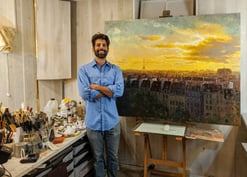
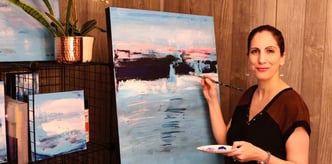
Duane BigEagle is a painter, creative writer, and poet whose work is shaped by his understanding of the power of visual and literary storytelling. As a member of the Osage Nation of Oklahoma, he was encouraged to embrace self-expression at an early age, and he approaches his work in ways that reflect this longstanding engagement with artistic practice.
His career as an artist has been shaped by extensive travel, decades of teaching in higher education, and the values passed down from his Osage ancestors. These experiences inform a body of work that combines carefully constructed imagery with narrative intent. Across mediums, Duane approaches his practice with a commitment to communicating ideas with both clarity and purpose.
Tell us about your journey to becoming a professional artist.
Since as early as I can remember, I’ve always been painting and drawing. I also started writing early in life and began teaching poetry and creative writing to young people in Northern California in 1976 through the California Poets in the Schools program. I’ve continued doing this for most of my life.
In 1989, I began teaching Native American Studies at the college level. I’ve taught at San Francisco State University, Sonoma State University, and I currently teach at the nearby College of Marin. I’ve always been a fairly slow painter and didn’t consider it a profession since it seemed to take me a long time to complete a piece. Over the years, my artwork collection has grown, and I now have a significant body of work which I’ve begun to take seriously. My creative writing was always steady and satisfying, and I’ve been published nationally and internationally. In 1993, I was awarded the Wallace Alexander Gerbode Poetry Award (a $10,000 prize).
Tell us about your work. What themes or messages do you hope to convey through your art?
In both poetry and painting, I use imagery to drive storytelling. The power of imagery sustains my work. In painting (I paint mostly in oils), I don’t see the canvas as a window, but rather a portal or gateway through which I try to send whatever the world seems to need at the moment. I am an American Indian from the Osage Nation of Oklahoma, and was raised with the concept and habits of collective consciousness, or responsibility to the group to which I belong.
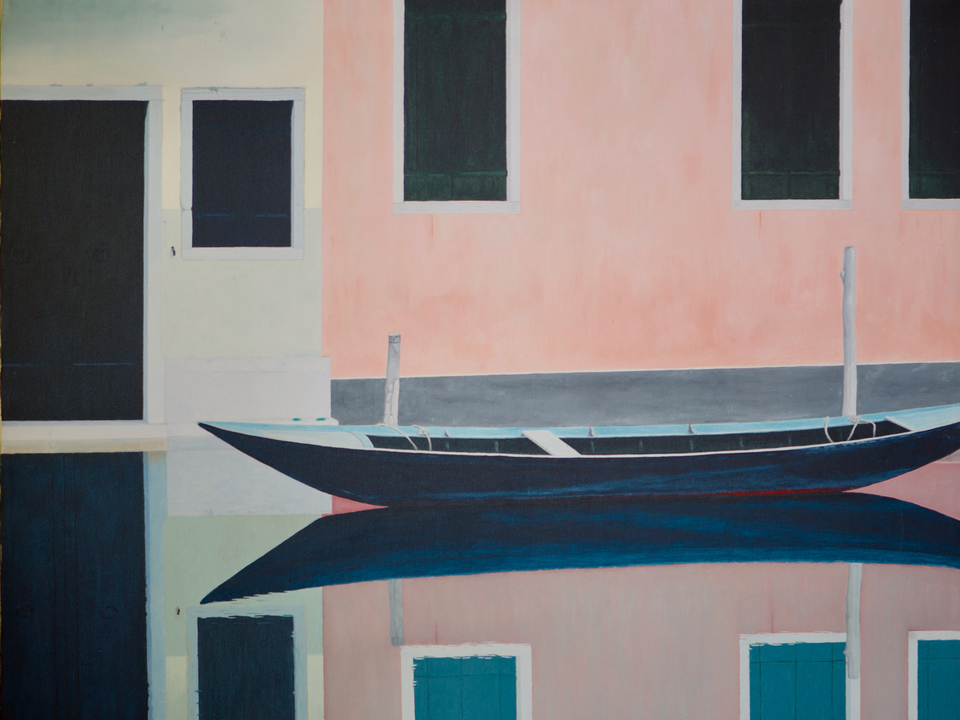
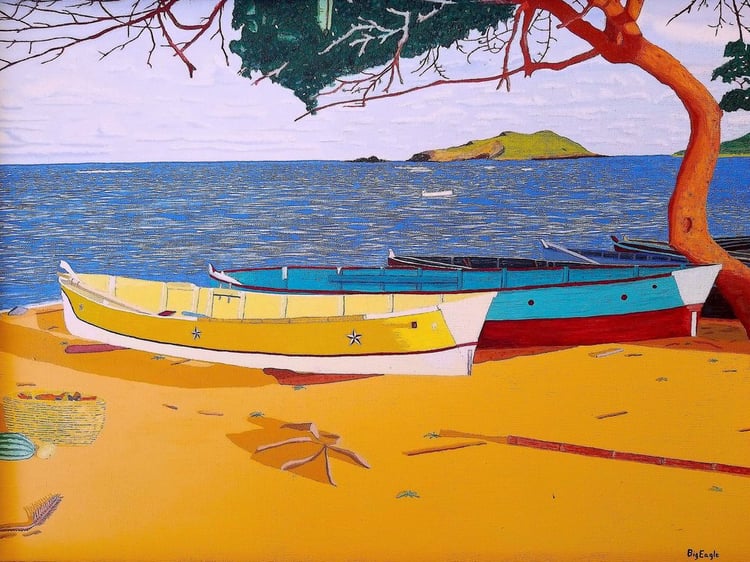
Growing up in Tulsa, Oklahoma, my father got a job at American Airlines, so travel has been part of my life since an early age and continues to be. My tribe had money from oil in the 1920s and 30s, which has led to a certain assertiveness that I adopted from my elders. It has always seemed natural for me to be as comfortable in the drawing rooms of Europe or the salons of Asia as I was around the campfires of my relatives and Osage elders. Since I've been able to travel more than most members of my tribe, I send images from my travels back to my Osage relatives. This has resulted in a series called “Postcards for the Osage.”
Tell us about your process. Do you have any unique techniques or rituals that are integral to your work?
As a poet, creative writer, and painter, these artistic forms have influenced each other. I typically work (and do my best work) when my mind and heart are clear. 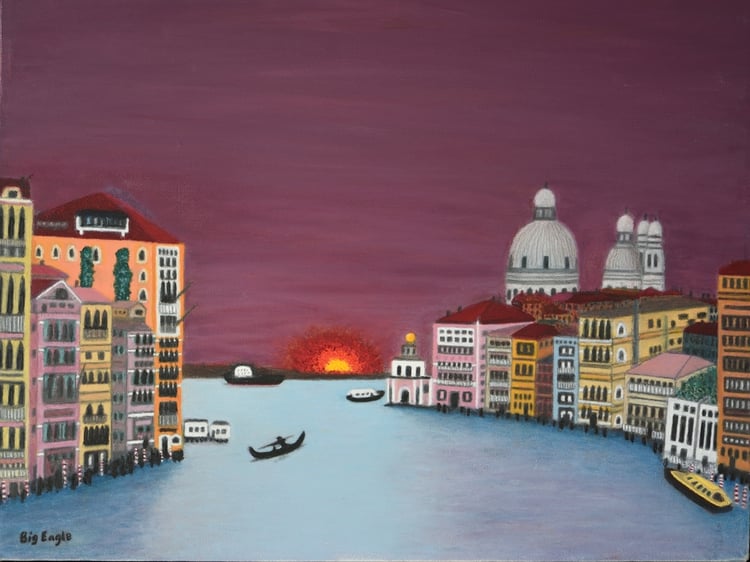
When you are looking for inspiration, what resources do you turn to? Are there any particular experiences, places, or people that influence your creativity?
Certainly, in painting, one of my greatest influences is the 19th-century Ukiyo-e woodblock print artist, Hiroshige. The simplicity and sophistication of his work are constant sources of inspiration. In writing, I’ve been most inspired by the Indian and Peruvian poet César Vallejo. He was fearless in linking the magnificent and the mundane to reach for the spiritual dimension of life.
Of course, I also look to the work of my Osage ancestors and their ideas about life and art. In the old days, if you made a shirt, you made a beautiful shirt. I don’t think we even had a word for art; it was so pervasive, all around us, enlivening our world. In writing and painting, I look for the unusual; that small thing that stands out, is a mystery, or shows spirituality.
Finding the right rhythm to be productive can be a challenge. What advice do you have for staying productive and focused as an artist?
This can be complicated. It’s best when you can follow your heart and artistic mind. My Osage elders used to say, “When making something of beauty, something that’s supposed to last, avoid working when your mind or heart is troubled.” Of course, you can’t always do this, and sometimes working can resolve troubles. But I know when I have something of value, it makes me want to work more. I try to avoid working just to be “productive.” When nothing grabs me in painting, I turn to writing.
What is your advice for combating creative blocks? Are there any specific strategies you use to reignite your creativity?
Just keep working. If I'm blocked in painting, I turn to something else but keep the creativity flowing. Once, I couldn’t paint for months, so I turned to tile work on the floor of my house. I was painting in floor tiles, assembling form and color, until I was ready to paint on canvas again. It taught me a lot.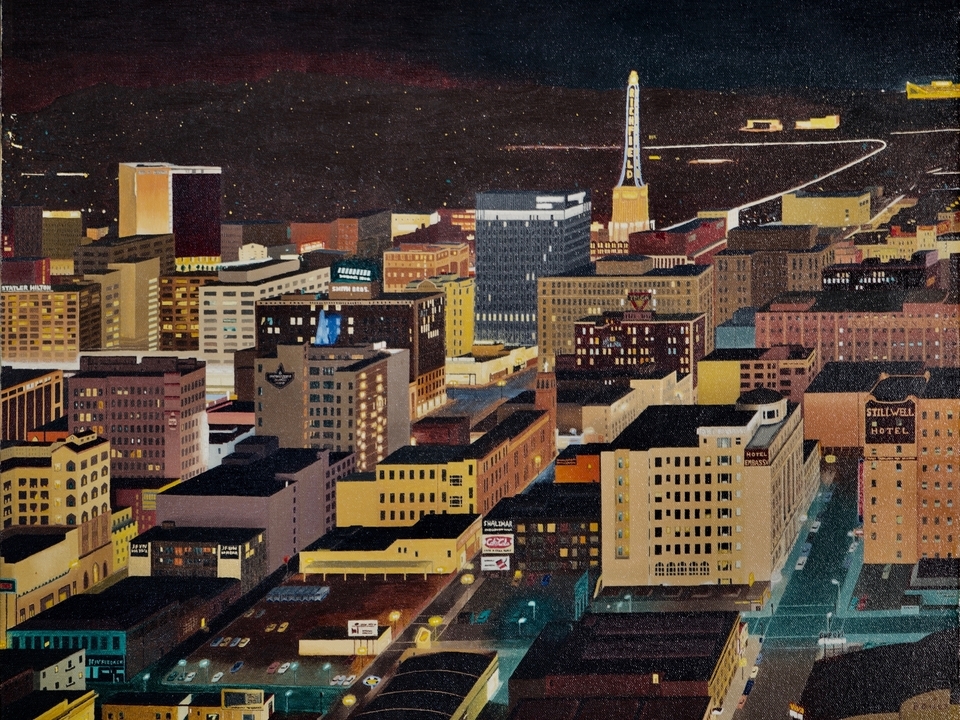
As an artist, how do you measure your success? Can you recall a specific event or milestone in your career that made you feel successful?
Usually, I can tell if I have something of value, but it’s not always easy. Early in my painting career, I had covered all my walls with paintings, so I volunteered to let my landlady borrow a painting every month. Month after month, she got a new painting to look at. Everything was fine until one month, she wouldn’t give the painting back. I had to laugh, but it taught me that even someone who isn’t trained in art can recognize and appreciate quality. She still has the painting.
Do you consider yourself, and all artists, to be entrepreneurs? Why or why not?
If we are entrepreneurs, I’m a bad one. All I want to do is creative work. If I didn’t feel the need to share my work, I wouldn’t do the “business of art” at all. I’ve been very lucky to have living situations that allowed me lots of time. Unlike many artists and writers, I haven’t felt the need to “be productive” just to pay for living expenses. Maybe that’s a disadvantage. Maybe I haven’t made as much art as I could have, but I’ve made work that satisfies me. Luckily, it seems to have found an audience.
Failure is an inevitable part of success in any field. Do you have advice for overcoming setbacks and staying resilient in the face of challenges?
If you love what you’re doing and it sustains your life, how can there be failure unless it stops doing that? I’m a very inner-directed person. I try to pay attention to the deepest levels of being. Perhaps I could share a poem:
Wind and Impulse // Each moment / rises up screaming into life, / born or stillborn. / There are some places you must not go. / Hate is a stone stairway / to a blank wall. / There are some chances you cannot pass up – / love, / a kind of readiness. / The little decisions / make a vision / by which we come to live. / You’d think what you’ve done / or haven’t done / would determine your happiness. / But is that really it? / Does a rabbit / blinded by the headlights of a car / know / if he’s going to run / or sit still? / I want to live / like that blinded rabbit, / piercing the darkness / for the slightest / wind and impulse.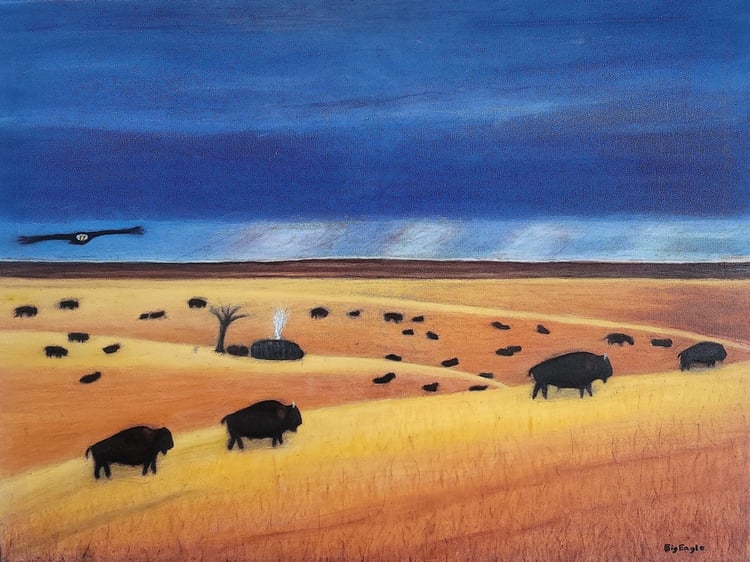
What sparked your interest in partnering with TurningArt? Has your experience with TurningArt differed from other art companies you have worked with?
I love the idea that there’s a company that can place my art in people’s everyday lives - in places I might not ever dream of displaying my work. What could be more valuable than sharing your experience? Giving another person a feeling, insight, or thought? A perception that enlightens, deepens their life, or lightens their load?
What does having your artwork in public spaces mean to you? How does it feel to see your art in environments where people can engage with it daily?
I love the recognition that comes with sharing my work (see answer above). But some of my work is meant mostly for my Osage people. A painting like “Medicine Lodge on the Osage Prairie” is intended to make Osages think about our heritage and to value it. It’s a scene of a buffalo herd on the prairie with a rainstorm in the distance. In the center is an old-time Osage lodge. None of the buffalo get too close to the lodge out of respect. It’s the lodge of a healer, a medicine person. And this is not ancient times, but the modern day. The two dark lines at the bottom of the painting, closest to the viewer, are pickup tire tracks. Being Eagle Clan, of course, I had to put an eagle in that sky. Sometimes what I choose to paint can carry a message to the viewers – and sometimes the viewers listen.
Was there ever a moment of clarity about being an artist? Can you share an anecdote relating to your journey or realization of being an artist?
Being Osage, I learned the value of perception and self-expression at an early age. In the Osage view, the Creator made this wonderful, amazing world, but there was no one to appreciate his creation. So he put human beings on Mother Earth. Our job is to see this world in all its beauty and terror, to learn from it, and to express who we are in the midst of its wild creation. At its most profound level, this is the job of the artist or writer.
How does being an artist affect your perception of the world? Do you see things differently compared to others who might not have an artistic background?
Perception is fundamental to being an artist or writer. Our job is to see clearly and to find a way to convey that perception, along with its feelings and thoughts, to the viewer or listener. In a painting like “The Gondola Factory,” one of my favorite places in the city of Venice, I’ve painted a very masculine place. Men are working on gondolas in different stages of construction, but in the center of the painting, on the second floor of one of the buildings, is a very feminine flower box with red geraniums. That contrast was what inspired me to make the painting.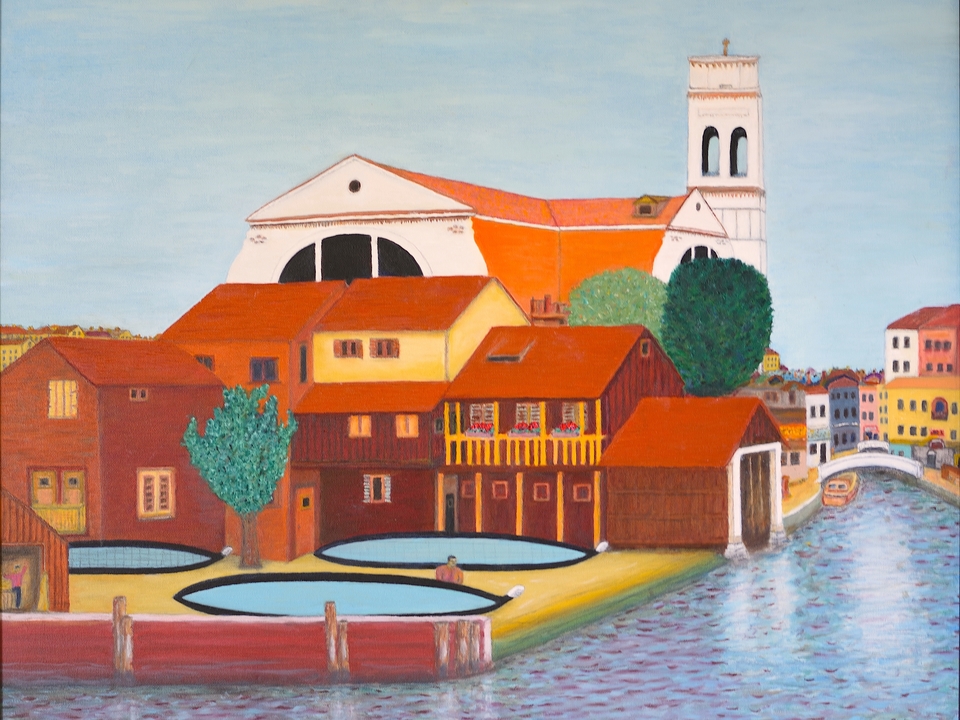
To see more featured TurningArtists, return to our blog. To get Jan von Holleben's art in your space, set up a free consultation with an Art Advisor here!