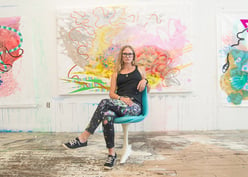
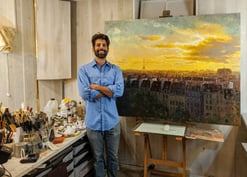
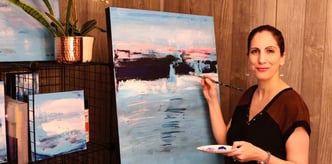
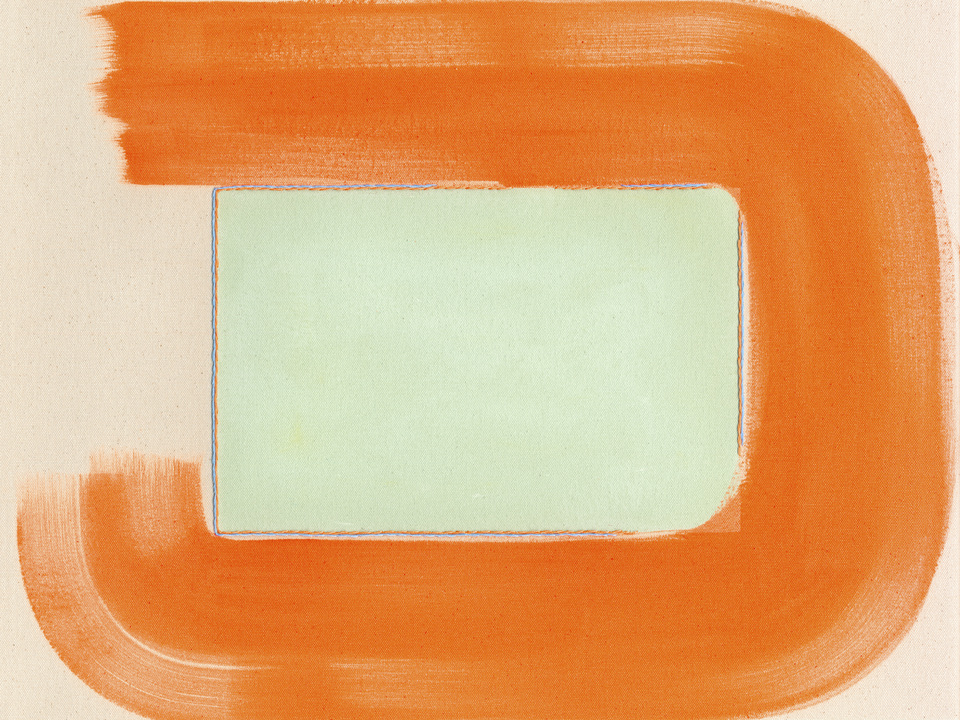
For Emily Keating Snyder, color has always been at the center of how she experiences and interprets the world. Drawn to creative expression from an early age, Emily's path to becoming a professional artist evolved through experimentation and a commitment to pursuing her passion. Her work blends contemporary abstraction with elements of craft and folk tradition, using embroidery and geometric composition to transform both fields of color into tactile, joyful visual experiences.
Tell us about your journey to becoming a professional artist.
I was very into art and anything creative growing up, but I would go back and forth between wanting to be an artist and thinking I had to do something more “responsible.” I remember lighting up every time I met someone who was an artist, a crafter, or did something with their hands.
The first defining moment in my artistic career path was quitting the last 9-5 job I had in my twenties to start my dog walking business, which supported my art career for many years. It was a meaningful stride, allowing me to make my own schedule so I could commit to art.
Tell us about your work. What themes or messages do you hope to convey through your art?
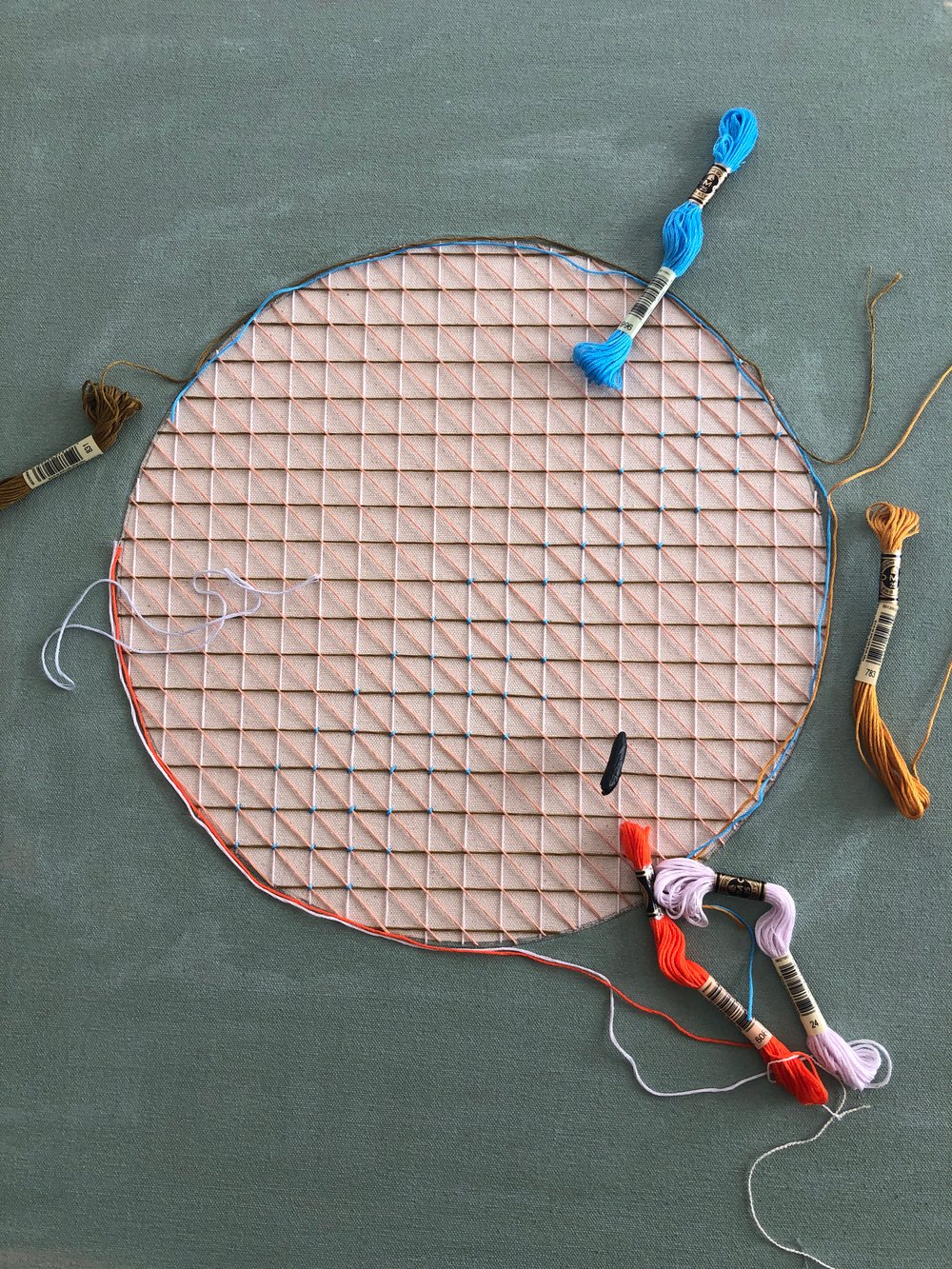
It always starts with color – color is definitely my biggest inspiration. I started adding embroidery to my paintings many years ago as a way to highlight and contrast with large fields of color. Simplicity and the joy of experiencing color are the primary themes in my work. I also approach my work with a desire to integrate craft and folk art into the world of contemporary painting – I love sharing that connection to the past.
Tell us about your process. Do you have any unique techniques or rituals that are integral to your work?
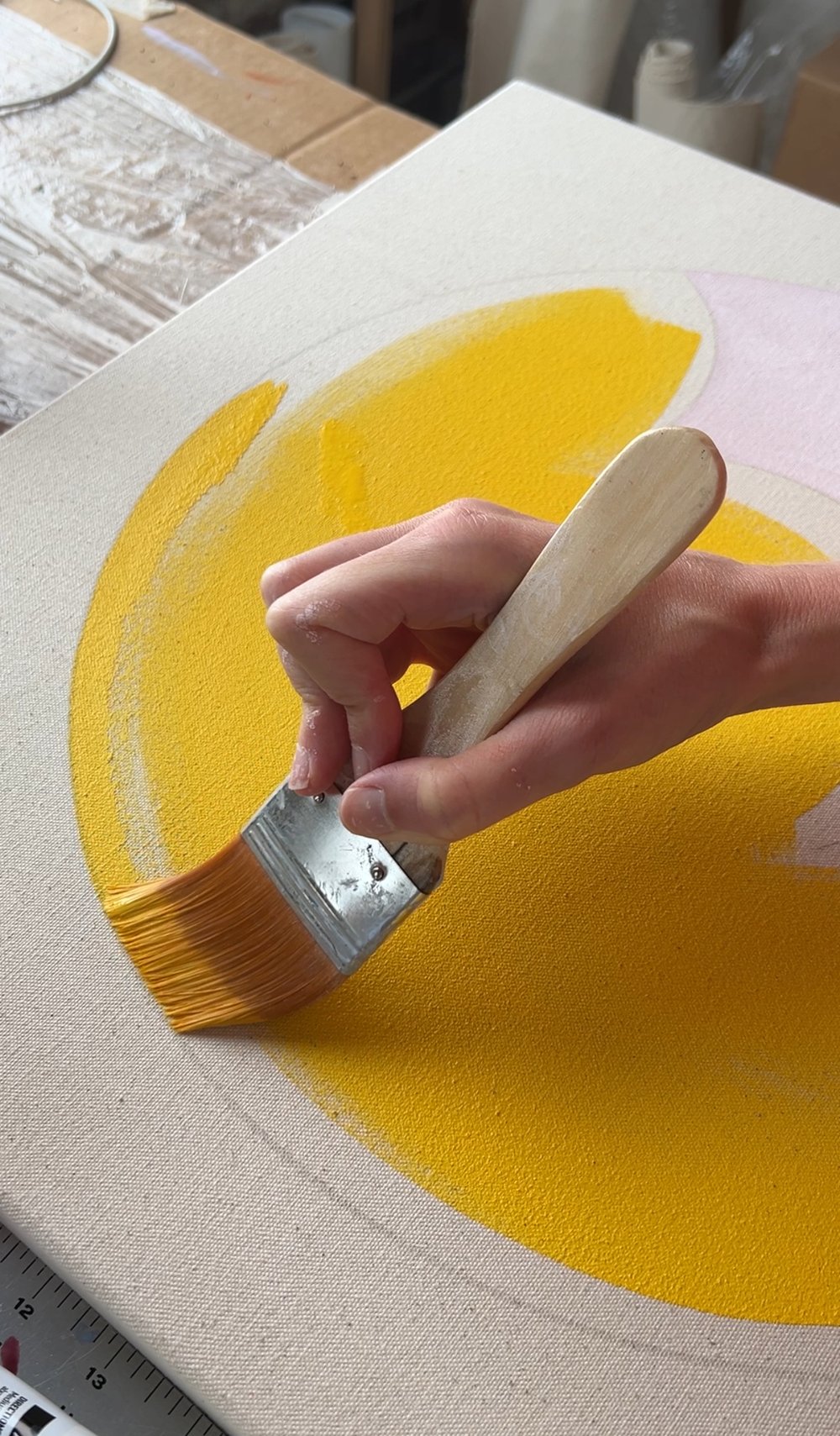
Mixing my paints to achieve the exact color I have in mind is probably the most time-consuming part of my process. After that, everything feels straightforward. I paint very quickly because wet paint warps raw canvas as it dries, and I often work on unstretched canvas. Although it may be unexpected, I love laying out my lines in pencil. I’m not a math person, so I feel especially accomplished when I nail the geometry and get things perfectly symmetrical. 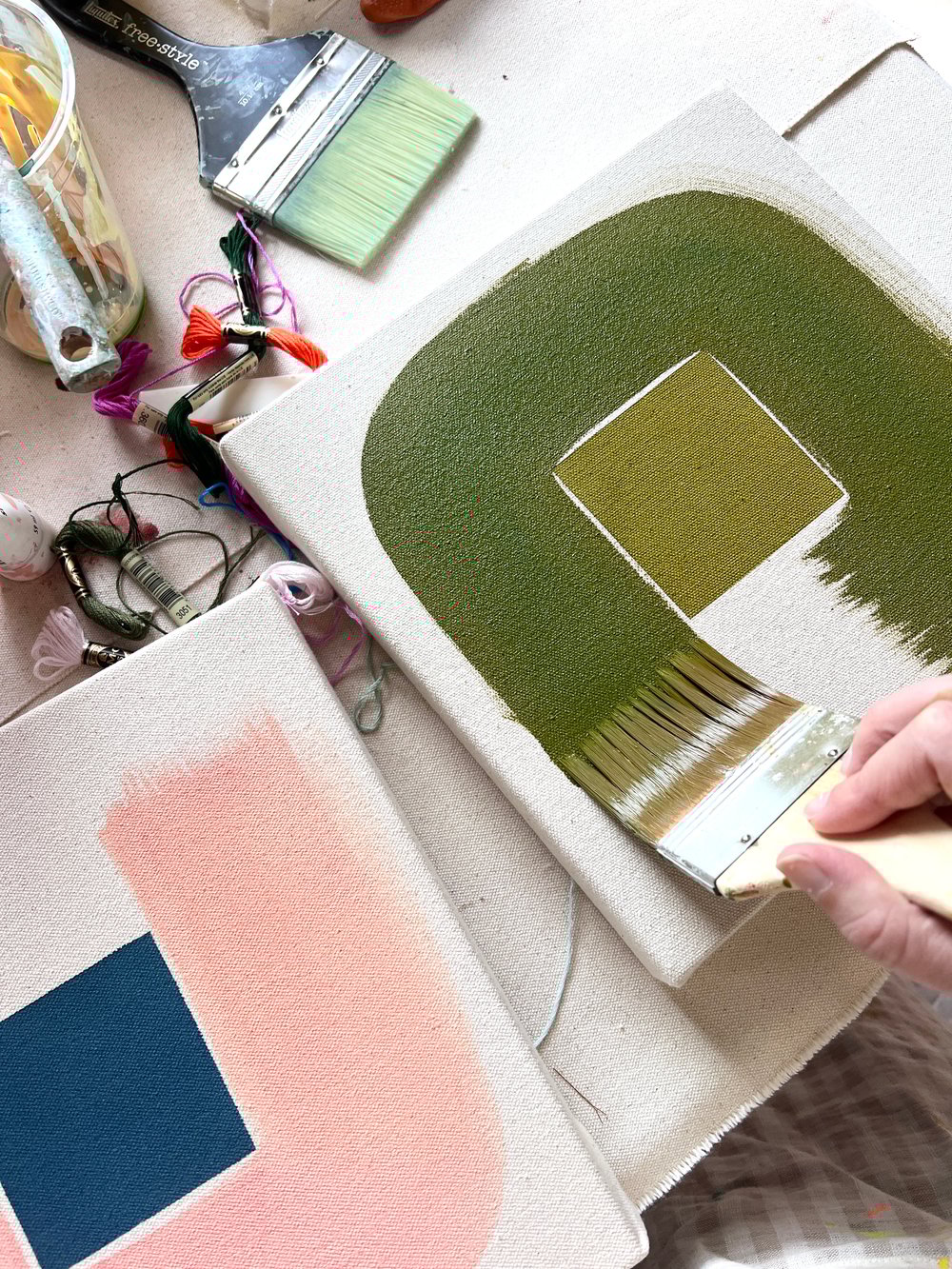
As an artist, how do you measure your success?
Measuring my success as an artist is a moving target. Some milestones that stand out are completing large commission projects for hotels and connecting with the galleries that represent me. I also still feel a burst of pride (and almost a sense of disbelief) when I see that a print order or a painting is going to a place I’ve lived before, especially if it’s on a street I walked down when I was younger, while I wondered if and how I could actually do this for a living.
What advice do you have for artists who are beginning to build their careers?
My biggest piece of advice would be to try everything. Selling looks different for every artist, whether it be through a huge Instagram following, a gallery, or an Etsy shop, for example. However, it usually takes time to determine which of those is the best fit for your work and your audience. I’ve given almost every outlet a shot, and some have been successful, while others have definitely not. But the only way to find out is to try sharing your art in as many ways as possible. That said, I’m very quick to stop doing things I don’t love! It’s all the data I need.
Repetition helps me decrease the level of importance I’m putting on something. I put so much pressure on myself to create something brilliant, and dwelling on this results in making only a few great things. But regularly flexing the creativity muscle by creating a lot of work (including some pieces that fall short) takes that pressure off.
And lastly, build a community of artist friends! I met many of mine through the internet. Most artists I’ve connected with are very quick to share tips, commiserate, cheer you on, and support you however you need. And of course, I’m happy to do the same for them.
Do you consider yourself, and all artists, to be entrepreneurs? Why or why not?
I would consider myself an entrepreneur to an extent (and I love it!), but I wouldn’t say all artists are. I definitely believe someone can be an artist even if they never make a dollar from their art or even share it with anyone.
Historically, most fine artists weren’t entrepreneurs because the outlets for selling were limited. Now, there are so many ways artists can diversify their income and have a mix (like I do) of their own platforms, like a website and Instagram, as well as working with galleries, art consultants, licensing prints, etc. Approaching things with an artist-entrepreneur mindset has definitely helped me expand my practice and sell more art.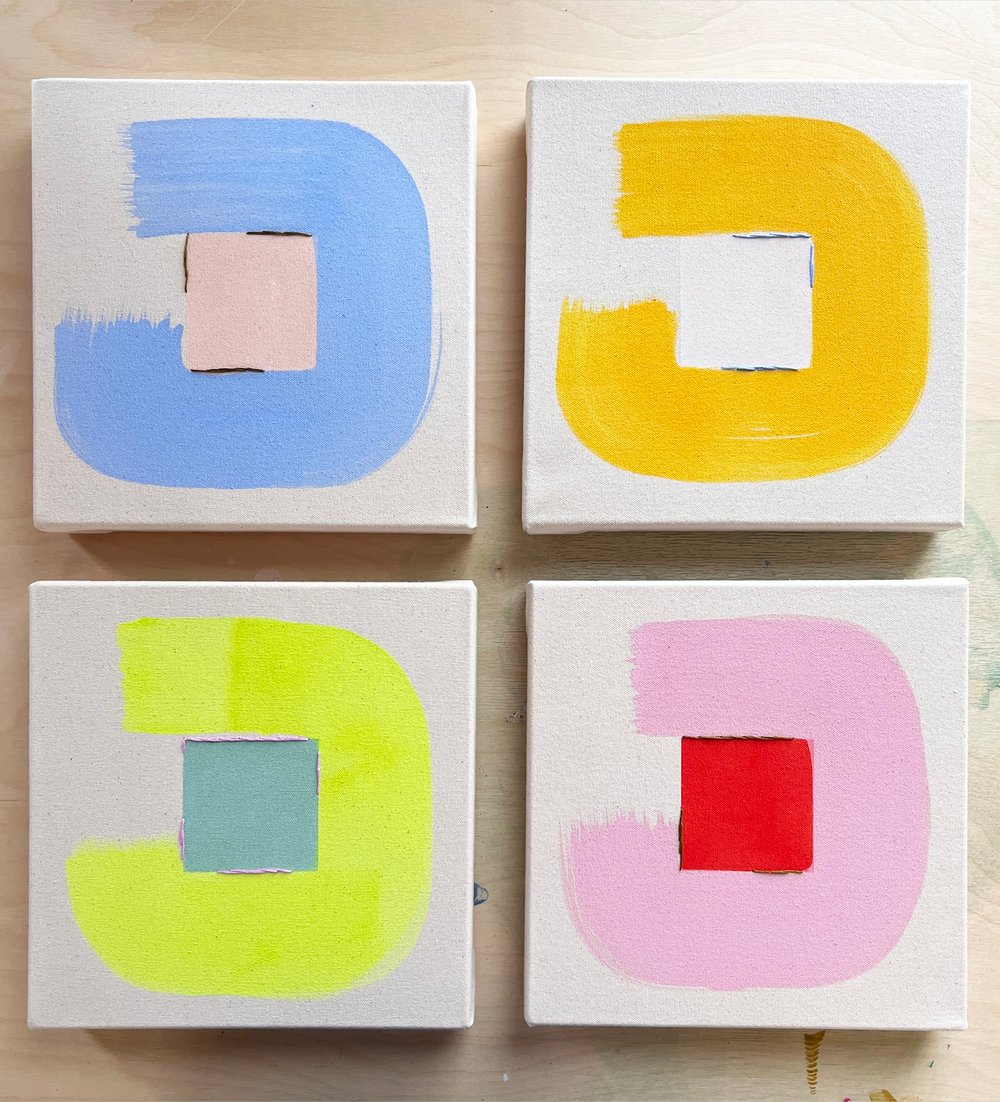
Failure is an inevitable part of success in any field. Do you have advice for overcoming setbacks and staying resilient in the face of challenges?
It’s much easier said than done, but a big part of staying resilient as an artist or creative is to resist comparing yourself to others. Success and failure are abstract and relative. Someone may feel successful hitting 5,000 Instagram followers and selling three original pieces, but might then experience self-doubt if they see someone online with 20,000 followers, selling out an entire art collection in a day. These experiences, for example, aren’t comparable. It’s best to avoid comparing “success” – everyone is in a different place and on a different path.
In terms of overcoming setbacks, I’d recommend two things. First, feel your feelings. If you feel sad or disappointed, let yourself feel that way for a bit before just moving on… and then get back on the horse. And two, I approach setbacks like an actor who goes on auditions – the auditioning is part of the job. Submitting your work to multiple galleries, presenting prints with art consultants for a hotel project, etc., are part of the job as an artist. A setback isn’t really a failure. You’re still doing the job of a working artist, and you’ll get wins along the way, too.
What sparked your interest in partnering with TurningArt?
I learned about TurningArt from a few fellow artists who inspired me to share my work (again, it’s great to connect with other artists and share tips!). I absolutely love that I can upload my art and have it readily accessible in a database for their art consultants to view at any time. It’s nice to have an ongoing centralized catalog that I can add to as I continue creating.
Was there ever a moment of clarity about being an artist?
I experienced a major moment of clarity when I was selecting my classes in college and was disappointed that many of the studio art classes I wanted to take were reserved for certain majors (somehow, not mine: Art History!). I was incredibly fortunate to grow up in a public school system that offered art classes as part of the curriculum, or at least as an elective every year.
I thought everyone wanted to make art all the time. I didn’t fully realize that it was such a unique interest of mine until later. As I continued through my college career and then entered the working world, I realized that there was truly nothing else I wanted to do.
How does being an artist affect your perception of the world? Do you see things differently compared to others who might not have an artistic background?
I believe being an artist, or simply a very visual person, definitely shapes the way I see the world. Even as a kid, I remember noticing and appreciating design and seeing art in everything. When I was a teenager, I was obsessed with taking photos of sewer covers in every city I visited. Other people found this odd, but some are actually quite beautiful. I’m still the same way; I notice every color and pattern around me and am always thinking visually. 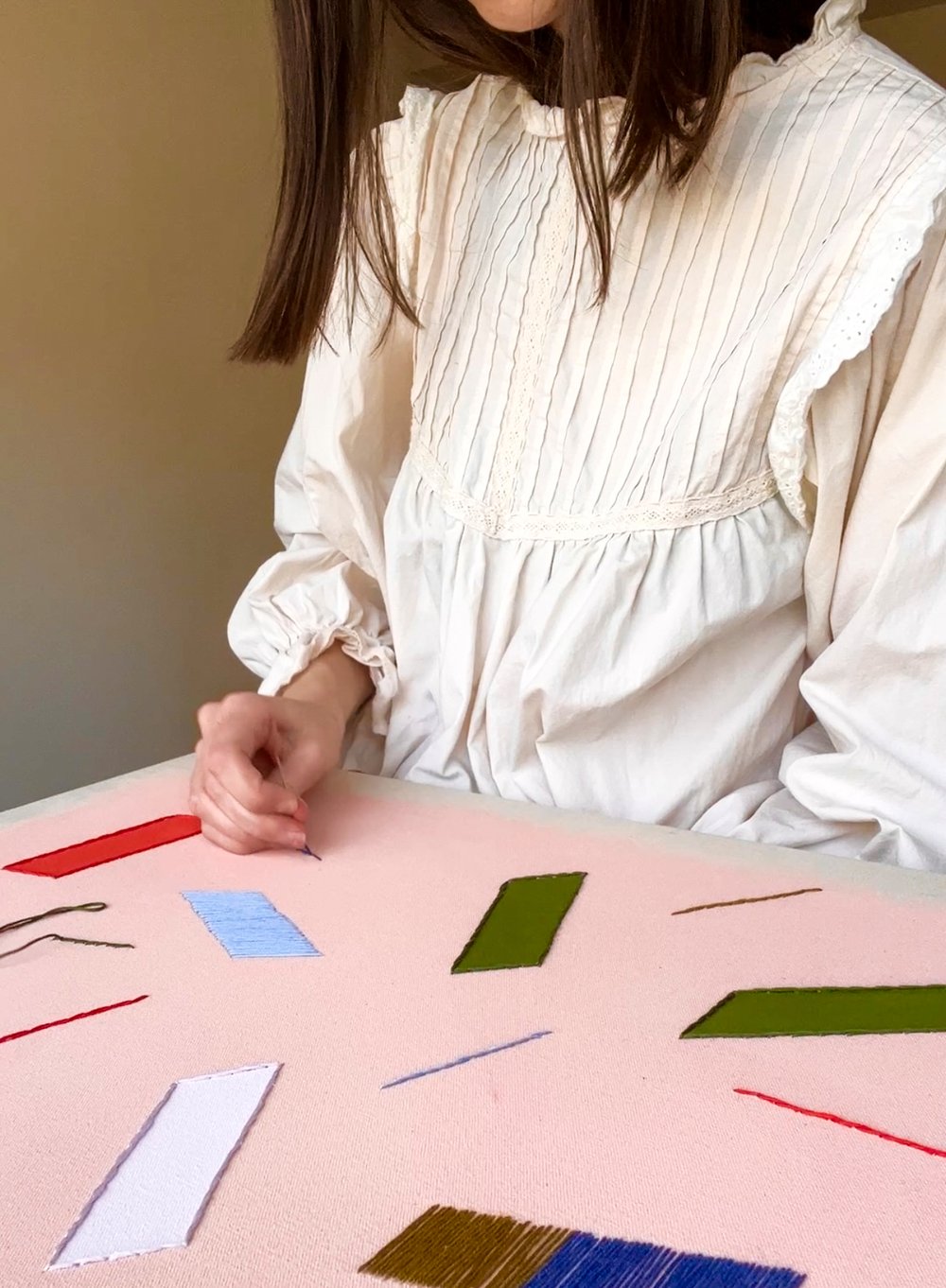
Have other artists inspired your path? If so, can you share how they have influenced your work or career?
I like to recognize a distinction between artists I admire and those who have influenced my work more directly. A big source of inspiration for me is Sol LeWitt. I’m obsessed with order and organization (which sometimes borders on anxiety). I learned about his work in a drawing class, and I distinctly remember how much it expanded my idea of creating art. I loved that his pieces were about consistency and structure.
Any artists who worked on a grid or with symmetry (Frank Stella, Agnes Martin) impacted and resonated with me because my brain works in the same way. At the same time, I’m a “glitter and rainbows” person at heart, so as I got older, I looked to artists like Mickalene Thomas almost for permission to use more color and varied materials.
What is most meaningful to you about being an artist? What drives you to continue creating and pursuing art?
When someone tells me that my art makes them think of their grandmother doing embroidery (which happens a lot, actually), that is really special for me. Bringing this ongoing history of women’s art into the spotlight is a big reason why I make what I make. Ultimately, what has always kept me going is that I can’t stop. It sounds cliché, but it’s absolutely true that artists make art because they can’t NOT do it.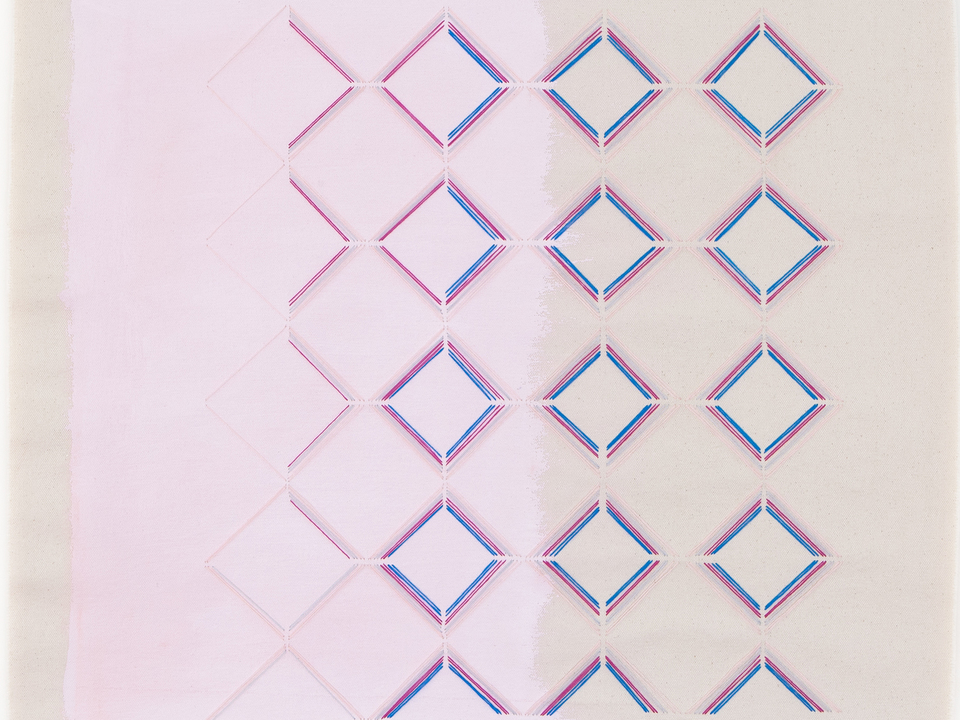
To see more featured TurningArtists, return to our blog. To get Emily Keating Snyder's art in your space, set up a free consultation with an Art Advisor here!