Across the country, behavioral health providers are navigating environments marked by rising acuity, chronic stress, and the emotional weight of patient care. In the middle of that landscape, one tool continues to stand out as a stabilizing force for well-being: art.
Our new whitepaper, Art as Infrastructure in Behavioral Health, created in collaboration with Dr. Kathleen Garrison, professor of psychiatry at Yale School of Medicine, offers a large-scale national snapshot of how clinicians across behavioral health view and use art in their care environments. Drawing from neuroscience, environmental design, psychology, and a multi-institution survey across 40 behavioral health centers, the findings make one thing clear: art is essential infrastructure for environments that support healing.
A National Look at the Impact of Art in Care
Providers reported remarkably consistent patterns across settings, roles, and patient populations. Among the findings:
- 97% reported arts-based interventions are valuable for patients.
- 62% observed reduced physical agitation after art engagement.
- Emotional regulation (69%)
- Willingness to discuss emotions (61%)
- Patient engagement in talk therapy (56%)
- Social interaction and communication (66%)
Together, these patterns point to something essential about the role art plays in behavioral health care. In environments where dysregulation, agitation, resistance, and isolation can quickly halt progress, art functions as both a powerful opener and a reliable stabilizer.
Providers described moments that underscore this impact:
“One patient with severe depression used card-stacking as a metaphor for his emotional ‘wall’—and then pointed to a crack that had formed. Art gave words to what words couldn’t.”
“Our adolescent patients with autism often struggle with transitions—but during art therapy, one paused his iPad for the first time without escalation.”
Qualitative insights like these surfaced across inpatient hospitals, outpatient clinics, private practices, and residential facilities, adding depth and dimension to the broader patterns clinicians reported.%20(1).jpg?width=1000&height=667&name=TBP_2193%20(1)%20(1).jpg)
Why Art Works in Behavioral Health Settings
Decades of research confirm that art directly engages the biological and psychological systems that behavioral health treatment works to support. Studies show that engaging with art:
- reduces cortisol, lowering physiological stress
- activates neural circuits responsible for emotion regulation
- supports cognitive flexibility, attention, and grounding
- improves patient-staff relationships, trust, and engagement
- provides a nonverbal pathway for expressing overwhelming experience
These effects illustrate how deeply art is intertwined with the mechanisms of healing in behavioral health settings.
Art as Infrastructure: The Key to Stronger Outcomes
Survey responses revealed that the most effective environments combine:
- A curated visual environment (permanent or rotating artwork, murals, sensory-regulating imagery)
- Arts programming (guided viewing, art-making, interactive workshops)
Providers working in spaces that had both saw stronger outcomes across nearly every measure. Conversely, institutions offering only one type (e.g., a single gallery wall or occasional craft workshops) reported lower patient engagement and more mixed outcomes.
This is why the whitepaper positions art as infrastructure: a foundational component of emotional regulation, therapeutic engagement, and workplace culture in care settings.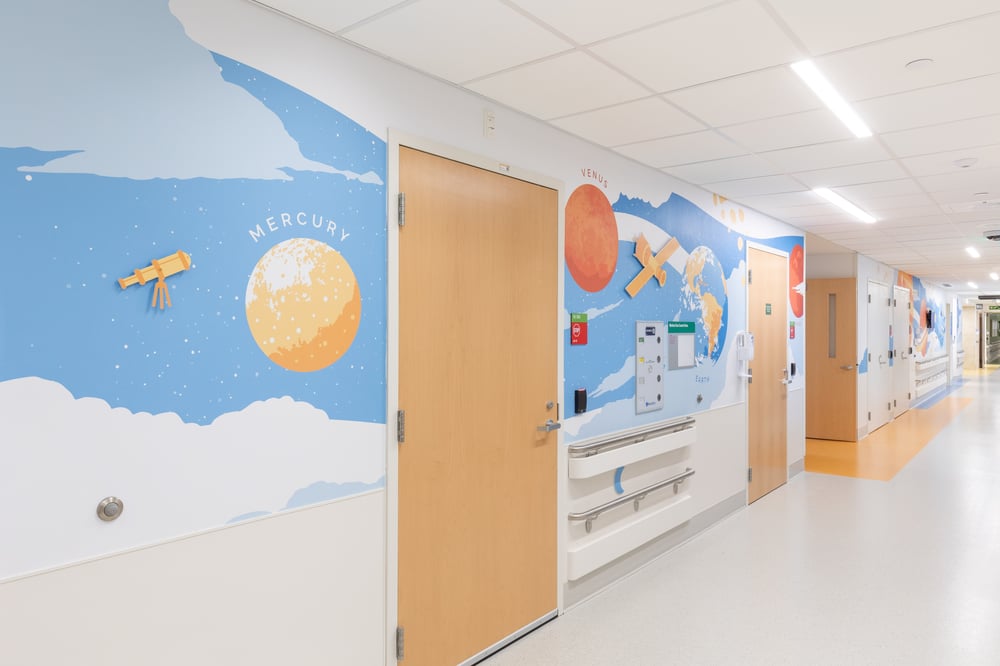
Beyond Patients: Art Improves the Clinician Experience
Behavioral health is facing a workforce crisis.Despite the pressures of high stress and burnout, staff described noticeable improvements when art was part of their environment. Among the findings:
- 67% reported that environmental art improved their workplace experience
- 79% reported improved team collaboration
- 93% agreed that art supports emotional well-being
What emerges from this data is a strong reminder: patient outcomes are inseparable from staff well-being. The environments that support staff ultimately support care.
Download the CARE Framework and Implementation Insights
The whitepaper offers:
- a synthesis of neuroscience and environmental design research
- national data on art’s perceived impact across clinical roles
- the CARE framework for arts integration
- insights on implementation, equity, and training
- real-world perspectives from providers on the ground
And most importantly, it provides a new vocabulary for a shift that’s already underway: from art as decoration to art as a core component of therapeutic environments.
For providers, designers, architects, researchers, and anyone committed to patient and staff wellbeing, the full whitepaper is available here:
Download: Art as Infrastructure in Behavioral Health
Designing environments that truly support healing requires attention to the full spectrum of human experience, including the sensory, emotional, relational, and neurological dimensions that shape daily life in care settings. Art is uniquely positioned to strengthen each of these layers, offering a practical and powerful way to create spaces that nurture both patients and the clinicians who care for them.
.jpg?width=1000&height=667&name=TBP_2110-HDR-Edit%20(1).jpg)
.jpeg?width=1000&height=667&name=1698086298364%20(2).jpeg)
Connect with an Art Advisor below to learn more!

.jpg?width=332&height=177&name=_MG_0840%20copy%20(2).jpg)
.jpg?width=332&height=177&name=dtBv_067_DSC_2139_DaNil%20(2).jpg)
.jpg?width=332&height=177&name=0046-Interior%20(4).jpg)

.jpg?width=332&height=177&name=OraSeaport3_6%20(1).jpg)
