Screens shape much of the modern workday. Employees move between video calls, documents, and inboxes, often with little variation in how they receive and process information. Over time, these demands can contribute to cognitive fatigue and make it more difficult to sustain focus, develop ideas, and move effectively between different kinds of work.
The physical workplace can help balance these demands. Thoughtful design interventions provide employees with cognitive experiences that are absent from most digital work and create an environment that supports concentration, reflection, collaboration, and creative thinking.
Studies on digital fatigue, attention restoration, and responses to original art offer insight into how employees are affected by their visual surroundings. For workplace leaders, the research supports the importance of designing office spaces that respond to the cognitive demands of modern digital work.
The Cognitive Demands of Screen-Intensive Work
Digital fatigue is often discussed as a consequence of time spent looking at a screen. In a landscape where daily work is inseparable from technology, it’s important to consider how sustained digital activity affects employees throughout the day.
A Microsoft WorkLab study used electroencephalogram, or EEG, readings to examine brain activity during consecutive video meetings. Among participants who attended four meetings without breaks, activity associated with stress increased as the meetings progressed. Participants who took short breaks between meetings showed a different pattern: stress-related activity returned closer to baseline, and measures of engagement improved when the next meeting began (Microsoft WorkLab, 2022).
When similar cognitive demands continue without meaningful variation, such as in uninterrupted digital work, their effects can accumulate and become exacerbated. Workplace design can help balance those demands by introducing physical surroundings that offer a broader range of sensory experiences, ultimately supporting concentration, reflection, and creative thinking.
How the Physical Workplace Can Respond
Addressing digital fatigue doesn’t necessarily mean reducing every screen interaction; instead, it means considering how the surrounding environment can help employees sustain focus and energy throughout the day.
Gensler’s 2026 Global Workplace Survey found that employees’ ability to learn effectively was associated with several qualities of the physical environment, including its look and feel, noise levels, and access to spaces that support focus. The findings show that workplace effectiveness depends on both functionality and design interventions..jpg?width=750&height=500&name=Final_Nonantum_%237%20(1).jpg)
What Art Adds to the Digital Workday
Visual art gives organizations a flexible way to shape a workplace that supports the demands of digital activities. Employees can encounter art throughout the day without stepping away from their work or adopting a separate wellbeing practice. These encounters introduce opportunities for reflection, creative thinking, and connection within an environment otherwise shaped heavily by digital information.
Attention Restoration Theory helps explain how visual surroundings can support sustained concentration. The theory proposes that demanding tasks can fatigue the directed attention people use to focus and filter distractions. Experiences that hold interest more effortlessly, such as viewing art or engaging with nature, allow that capacity to recover (Kaplan, 1995). The research demonstrates the value of designing workplaces with visual experiences that engage employees without adding to the concentration required by their work.
Research on the impacts of viewing art also indicates that non-digital visual experiences can positively impact the body’s stress response. In a 2025 study of 50 adults, participants who viewed original artworks in a gallery experienced an average 22% reduction in cortisol, compared with an 8% reduction among participants who viewed digital renderings of the same works (The Courtauld, 2025). For workplaces centered around technology, the findings not only reinforce the value of integrating art into the office, but also the importance of creating opportunities for cognitive recovery through experiences that do not depend on another screen
Art can also encourage self-reflection and personal connection, supporting critical thinking and problem-solving skills. In a study using neuroimaging to explore the impact of art on the brain, researchers found that when participants considered an artwork to be impactful or moving, the brain regions involved in information processing and personal reflection were activated (Vessel, Starr, & Rubin, 2012). Participants across the study responded strongly to diverse types of works, showing that meaningful engagement does not depend on a single artistic style.
While workday responsibilities largely live within a screen, a thoughtfully designed physical environment can help counter the cognitive strain created by sustained focus and rapid information processing while supporting reflection, connection, and creative thinking. Integrating art into the workplace makes these forms of cognitive support part of employees’ everyday experience.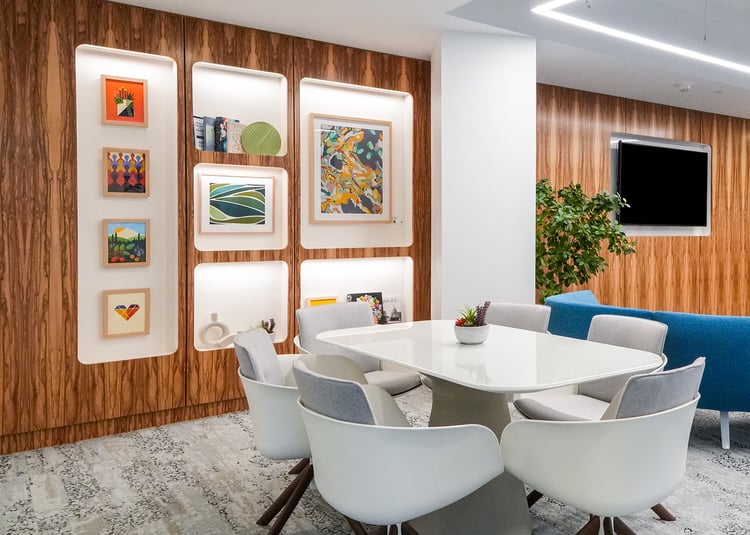
Designing for the Modern Workday
Applying these findings begins with understanding where screen-intensive work places the greatest demands on employees and how the physical environment can better support them. Workplace leaders can use those needs to guide decisions about where art is integrated, what experiences it should create, and how it contributes to the workday as a whole.
An effective visual environment responds to how people use the workplace and what the organization wants the physical office to support. Thoughtfully integrated art brings opportunities for cognitive recovery and connection into a workday increasingly shaped by screens, helping create an environment that supports sustained focus, reflection, and creative thinking.
How TurningArt Can Help
At TurningArt, we understand how the physical environment shapes the employee experience. We work with organizations to create art programs that support their people, workplace goals, and spatial needs. Our Art Advisors consider each set of unique priorities to curate collections that create opportunities for focus, reflection, and connection.
With options to purchase, lease, rotate, or commission original artwork, organizations can develop an art program that responds to their current needs and evolves alongside their workplace..jpg?width=720&height=480&name=0027-Interior%20(1).jpg)
Connect with an Art Advisor below to learn more!

.jpg?width=332&height=177&name=0046-Interior%20(4).jpg)
.jpg?width=332&height=177&name=_MG_0840%20copy%20(2).jpg)
.jpg?width=332&height=177&name=dtBv_067_DSC_2139_DaNil%20(2).jpg)