The Momentum Behind Arts in Health
Science and the arts continue to intersect in new and exciting ways, with social prescribing emerging as a growing topic of conversation. This healthcare approach involves physicians prescribing community-based activities in place of, or alongside, traditional medications, often including creative and arts-based activities. A “prescription” might take the form of a hiking club, a pottery class, visiting a museum, or community gardening. Social workers, known as “link workers,” take the time to understand each patient’s needs and connect them with an activity that aligns with their interests and circumstances. They also help minimize barriers to participation and support patients in following through on their “dose” of the activity, whether that means attending a weekly class or joining a group activity each month. The goal is to establish a consistent behavior that can become part of a person’s ongoing routine.
Art and health researchers are deliberately adopting medical language, using words like “dose” and “prescription,” to reinforce that this is a form of healthcare. This approach instead addresses the social determinants of health, or the non-medical factors that influence health, more holistically than traditional medicine (Cook, 2026).
Although social prescribing began in the U.K., the movement has seen immense global momentum over the last five years. According to Google Trends, searches for “social prescribing” are up 300% over the past five years internationally, and up more than 5,000% in the United States, with a particularly large spike in 2026. This momentum aligns with a broader interest in neuroarts, the interdisciplinary field of neuroscience, psychology, and art, as international searches for “neuroarts” are also up more than 5,000% over the past five years.
As research on these topics grows, the fields gain credibility, financial support, and attention, marking a significant shift in the perception of arts in health. 
Origins of Social Prescribing
While prescribing social activities may seem contemporary, the core concept can be traced back to 1926 in London. Founded by two doctors, “The Peckham Experiment” was a pioneering health center that aimed to answer the question: what allows health to develop and flourish? They invited 950 local families to join a community wellness club for a small fee. The club offered regular health check-ups and a range of activities including exercise classes, swimming, games, and arts-based initiatives. Participation in these activities was consistent and became an integrated part of the families’ lives, serving as the local hub for belonging and community. The facility itself exemplifies many of the same architectural concepts that we see tied to well-being today: open-floor plans, plenty of natural light, and biophilic design. The health center was widely beloved and considered successful by the local residents, until it ultimately closed in 1950 following World War II and the arrival of the new National Health Service (The Peckham Experiment).
Now in the 21st century, the same values positioning community and arts-based initiatives as beneficial to long-term health are the foundation of social prescribing.
Art as a "Dose"
To maximize the efficacy of community and arts-based health “prescriptions,” the “dose” of the activity must be repeated and sustained. Participating in a running club once or taking a painting class has short-term benefits, but doesn’t necessarily produce long-lasting results. Research on prescribing “cultural doses” consistently points to the importance of repeated exposure: a 2020 study used data from the English Longitudinal Study of Aging to identify how the length of arts engagement impacts well-being outcomes in older adults. The data were collected between 2004 and 2014, and arts engagement was analyzed by the frequency at which participants attended films, art galleries, or concerts. The data revealed that sustained and repeated engagement, taking place every few months or more during the majority of the 10 years, was associated with long-term well-being, increased autonomy, and self-realization compared to short-term arts engagement (Tymoszuk et al., 2020).
Additionally, a recent longitudinal study associated with Johns Hopkins University analyzed the effects of arts-based social prescribing on 240 participants. Data on participants’ self-reported feelings of well-being were recorded from May 2023 to July 2025, and researchers found that participants experienced statistically significant and sustained increases in well-being during the social prescribing program. Specifically, patients experienced a peak of 18-20 points on the WHO Well-Being Index, where an increase of 10 points indicates a meaningful change in well-being. Most notably, the data suggested that the duration of treatment was not the primary well-being driver, and instead it was sustained engagement in social prescribing programming that made the biggest impact on patients’ mental health (Bailey & DiMilia, 2026).
Ultimately, these studies underscore the importance of integrating the arts into our daily lives, as consistent engagement is directly associated with well-being.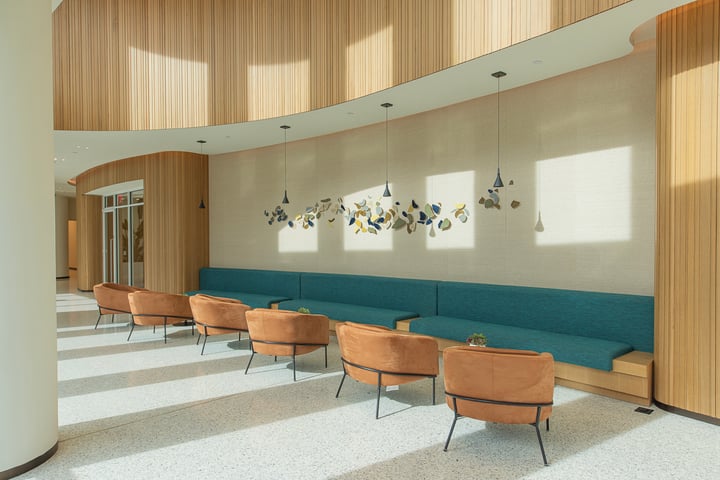
The Design Implication
The growing body of research around social prescribing points to a broader lesson: designing for well-being is not only about creating spaces that promote well-being in the moment, but about creating environments that support healthy behaviors over time. If repeated exposure and sustained engagement are key to the benefits of arts-based activities, then the spaces where people live, work, and receive care can be designed to make those experiences more accessible, inviting, and integrated into everyday life. Art should go beyond a one-time activity and instead become integrated into the everyday experience, fostering connection, creativity, movement, and moments of reflection on a regular basis. In this way, designing for well-being means thinking beyond the immediate functionality of a space and considering how design can support the routines, behaviors, and experiences that contribute to well-being over time.
How TurningArt Can Help
Whether used as a form of treatment in a healthcare setting, as decor in a corporate space, or as a hands-on activity that fosters community connection, art is science-backed for well-being. For organizations looking to make art part of the everyday environment, this suggests an opportunity to think beyond a one-time art purchase and toward ongoing programs with a consistent cadence. TurningArt specializes in bringing art into the built environment across healthcare, workplace, and commercial real estate settings, with a deep understanding of how art can shape the experience of a space. Through scalable lease, rotation, and purchase programs, we help organizations shape holistic spaces designed to support the evolving identity, goals, and needs of each space.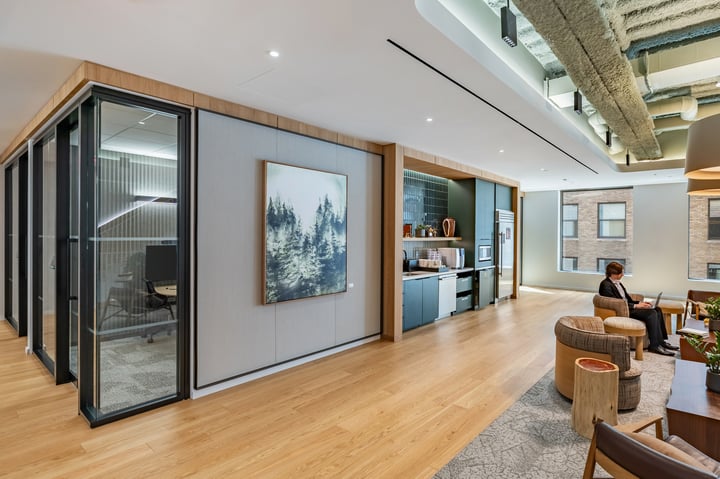
Connect with an Art Advisor below to learn more!

.jpg?width=332&height=177&name=_MG_0840%20copy%20(2).jpg)
.jpg?width=332&height=177&name=dtBv_067_DSC_2139_DaNil%20(2).jpg)
.jpg?width=332&height=177&name=0046-Interior%20(4).jpg)